RestoreAdults
12 Tiny Habits That Improve Sleep (Backed by Behavioral Science)

Hatch
Summary
This guide highlights 12 small, behaviorally grounded habits that make falling asleep easier (without overhauling your entire sleep routine). Each tip is quick, approachable, and rooted in research on habit formation and sleep hygiene, making it easy to build lasting change.
____________________________________________________________________________
Building better sleep habits sounds great in theory, until real life gets involved. By the time evening rolls around, you’re juggling leftover to-dos, racing thoughts, and the gravitational pull of your phone (hardly the calming wind-down moment you dreamed about). You’re not doing anything wrong if you struggle with maintaining a calming bedtime routine. Your brain is just busy and trying to keep up!
That’s why tiny, science-backed habits matter so much. Small changes don’t overwhelm your already-full mental load. Instead, they gently guide your nervous system toward rest, no complicated routines required. Tonight, try one or two of these micro-habits and see how quickly your evenings start to feel more restful.
Table of contents
- Why Tiny Habits Work Better Than Big Changes
- 12 Behavioral Science Sleep Tips to Try Tonight
- Key Takeaways
- FAQs
- References
Why Tiny Sleep Habits Work Better Than Big Changes
When it comes to building better sleep habits, small actions almost always outperform big, sweeping changes. Micro-actions carry a much lower cognitive load (they’re easier to do!), so your brain doesn’t resist them like it does with hard, long, or complicated tasks. Because tiny habits create quick wins, they give you an immediate hit of positive reinforcement. That feel-good “I did it” moment that makes you more likely to repeat the behavior tomorrow.
Over time, these small wins compound. Even one consistent sleep cue each night builds predictability, which is more powerful than trying to build a “perfect” routine. Over time, your nervous system will learn the pattern, making it easier to settle down, fall asleep, and stick with the habits you’ve created.
12 Behavioral Science Sleep Tips to Try Tonight
Ready to start your own micro sleep routine for better rest? Here are 12 tiny sleep habits, backed by scientific research.
Dim one light in your home 30 minutes before bed
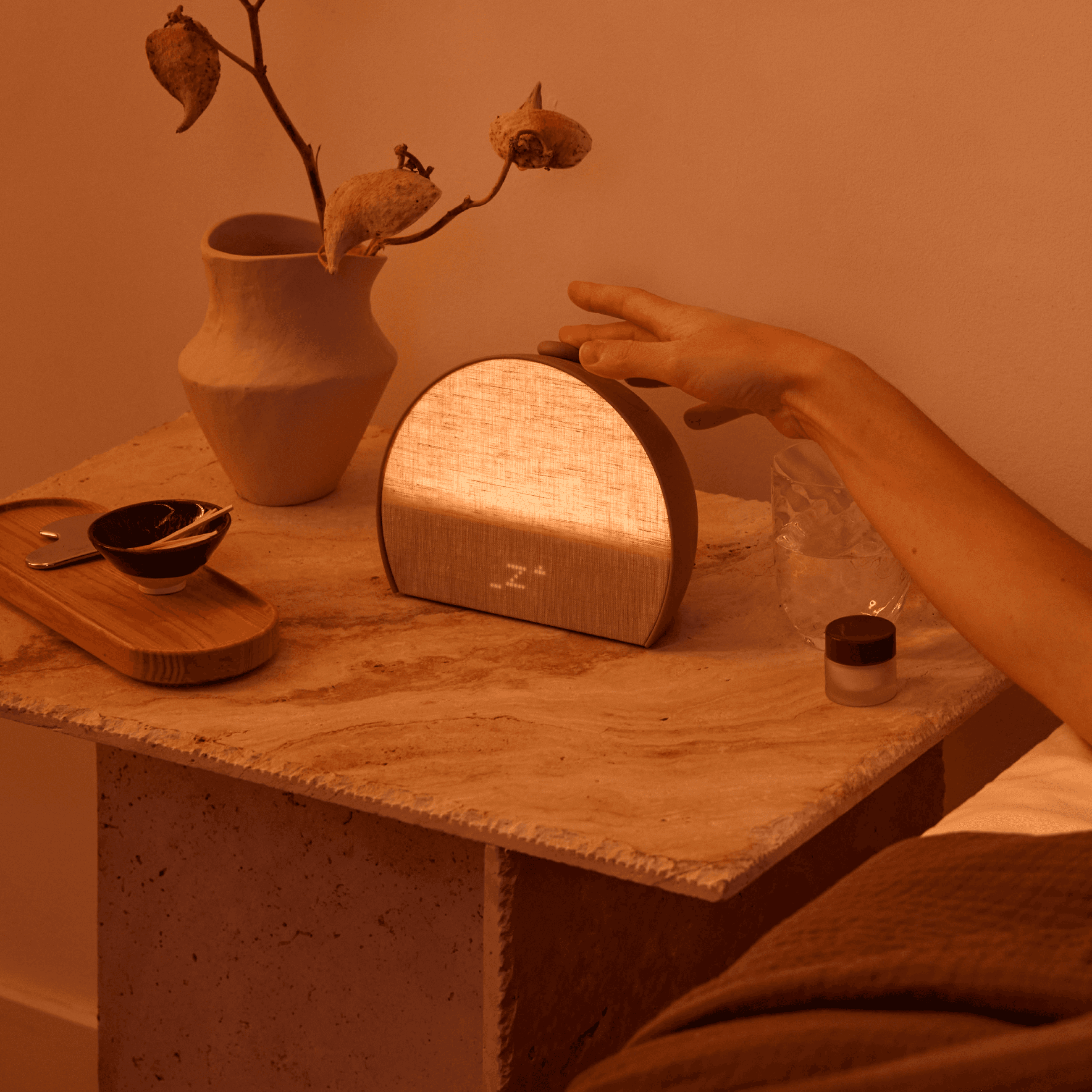
Light is one of the strongest cues for your circadian rhythm. While morning light helps you wake up energized, dimmer night in the evening can signal it’s time to wind down. One study found indoor lighting levels can significantly affect the release of melatonin, so try to swap your big lights for dimmer lighting about 30 minutes before bed. Pro tip: Amber light on your Hatch Restore is one of the most effective light hues for supporting melatonin release.
Do a 2-minute room reset where you sleep
If your room is cluttered, a quick reset can signal to your brain that the space is calm, making it easier to fall asleep. Studies show environmental order can actually reduce the effects of stress, so a calm space could help you feel more relaxed for sleep. Even if you just pick your clothes up off the floor or clear off your dresser, you’ll have less visual distraction (and a lower cognitive load for tomorrow).
Pair bedtime with a consistent sensory anchor
Research suggests context is a powerful cue for creating new habits, and that combining new habits with ones you already do is a helpful way to automate routines. At bedtime, choose habits that create a more relaxing environment. For example, every time you put on your pajamas, you could spritz your pillow with a cozy lavender spray. Over time, your brain will associate the PJs with the spray, making the new behavior feel automatic (and your bedroom that much comfier).
Put your phone to bed before you put yourself to bed
Studies show spending time on screens — including doomscrolling — before bed can keep your mind active and suppress melatonin release, making it hard to fall asleep. Limiting screen time reduces blue-light melatonin disruption and racing thoughts. Need a reminder? Hatch Restore’s Goodnight, Phone feature automatically cues you to put your phone away at a pre-set curfew, so you can pivot to more relaxing activities instead.
Sit down and take five slow breaths
Speaking of relaxation: Diaphragmatic breathing, or taking deep and slow belly breaths, has been shown in research to soothe the nervous system and reduce the effects of psychological and physical stress. Before bed, take 30 seconds to a minute to breathe in and out deeply and slowly, and notice as your brain and body shift to a calmer, sleepier state.
Cross a to-do off your list
Cognitive load has been linked in research with difficulty falling and staying asleep. If racing thoughts about tomorrow’s to-do list tend to keep you up at night, try reducing mental clutter by doing one item on your to-do list before bed. Picking tomorrow’s outfit, putting together your lunch for work, or even queuing up the coffeemaker can reduce your mental load, so bedtime feels more peaceful.
Create a sleep cue with temperature
Ever notice it’s easier to fall asleep or you sleep better when your room is cooler? That’s science! Cooling the body helps you sleep deeper and more consistently by lowering your core temperature. So if you can, switch your thermostat to 68-72°F. Breathable sheets and PJs can help, too!
Replace scrolling with a simple, soothing activity
Behavioral substitution, replacing an undesired habit with an easy, compatible one, is one of the most effective strategies for long-term habit change. At bedtime, swapping late-night scrolling for another low-effort calming activity can make it easier to unwind. Try something so simple it feels hard to resist, like doing a mini crossword, reading a few pages of a book, or listening to a funny podcast (like Hatch Restore’s bedtime podcast The Nightly) on your Restore. These “frictionless alternatives” break the automatic cue-driven loop that keeps you grabbing your phone at night.
Do a quick grounding check-in
A short grounding ritual can help your brain shift out of “go mode” and into a more restful state. No need for a full meditation session: For two minutes, gently notice your breath, the weight of your body, or the sounds around you. This tiny pause lowers cognitive and physiological arousal, reducing the mental run-around that can keep you awake. If you need some guidance, try a meditation or deep breathing exercise on your Hatch Restore (best paired with a cozy amber light).
Move your body for 2 minutes sometime in the evening
Just a little movement can go a long way. Even a quick 2-minute stretch, shake-out, or slow walk around your home can help loosen built-up tension and prevent the restlessness that often shows up at bedtime. Research backs this up: Even brief bouts of physical activity reduce muscle tension and support better sleep.
Write down one thing you enjoyed today
Positive reflection and gratitude can reduce stress and counter rumination, improving your ability to fall and stay asleep (and your overall well-being). Take time before bed to write down three good things that happened that day. Even small wins like a funny comment or something you completed signal safety to your brain and help shift your mood into a calmer state before sleep.
Use sound therapy to support sleep
Sound can be a powerful cue for settling your mind and easing into rest. Gentle, consistent audio, like White Noise, Brown Noise, or Pink Noise helps mask background noise and creates a stable auditory environment that signals your brain it’s safe to relax. Research supports this: Studies show continuous ambient sound therapies may improve sleep quality, especially for people in noisy or unpredictable environments.
Hatch Restore offers a range of soothing soundscapes you can set to play automatically during your Unwind Routine or throughout the night. With one tap, you create a consistent auditory cue that helps your body transition into deeper, uninterrupted sleep.
Key Takeaways
- Consistent sleep routines support a healthy circadian rhythm and signal to your brain and body that it’s time to shift from “go mode” to a more restful state.
- Even short and simple bedtime habits can go a long way in supporting your sleep quality and duration, helping you feel more energized in the morning.
- Hatch Restore supports all your bedtime routine goals with Cues to Unwind, soothing lights and audio, and a Goodnight, Phone feature that reminds you to swap your phone for sleepy activities.
Explore how Hatch Restore can help you create bedtime habits you’ll actually stick with, so you can get deeper sleep.
Frequently Asked Questions
How soon will these micro-habits improve sleep?
Building habits (and seeing improvements) takes time! Most people notice a shift in calm and readiness within days, but lasting improvements come with consistency.
Do I need to do all 12 habits every night?
Not at all! These are “choose-one” tools you can rotate or stack gradually over time. Try experimenting with small habits and notice what makes the biggest difference in your sleep quality and duration.
Can these habits replace a structured bedtime routine?
Yes and no. If you already have a sleep routine, great! These habits fit within it. If you don’t, try gradually combining some of these small, evidence-based habits into a nightly ritual.
References
- Black, D. S., O’Reilly, G. A., Olmstead, R., Breen, E. C., & Irwin, M. R. (2015). JAMA Internal Medicine, 175(4), 494–501. https://doi.org/10.1001/jamainternmed.2014.8081
- Gooley, J. J., Chamberlain, K., Smith, K. A., Khalsa, S. B. S., Rajaratnam, S. M. W., Reen, E. V., Zeitzer, J. M., Czeisler, C. A., & Lockley, S. W. (2011). Exposure to room light before bedtime suppresses melatonin onset and shortens melatonin duration in humans. The Journal of Clinical Endocrinology & Metabolism, 96(3), E463–E472. https://doi.org/10.1210/jc.2010-2098
- Harvey, A. G. (2002). A cognitive model of insomnia. Behaviour Research and Therapy, 40(8), 869–893. https://doi.org/10.1016/S0005-7967(01)00061-4
- Hopper, S. I., Murray, S. L., Ferrara, L. R., & Singleton, J. K. (2019). Effectiveness of diaphragmatic breathing for reducing physiological and psychological stress in adults: A quantitative systematic review. JBI Database of Systematic Reviews and Implementation Reports, 17(9), 1855–1876. https://doi.org/10.11124/JBISRIR-2017-003848
- Jackowska, M., Brown, J., Ronaldson, A., & Steptoe, A. (2016). The impact of a brief gratitude intervention on subjective well-being, biology and sleep. Journal of Health Psychology, 21(10), 2207–2217. https://doi.org/10.1177/1359105315572455
- Kredlow, M. A., Capozzoli, M. C., Hearon, B. A., Calkins, A. W., & Otto, M. W. (2015). The effects of physical activity on sleep: A meta-analytic review. Journal of Behavioral Medicine, 38, 427–449. https://doi.org/10.1007/s10865-015-9617-6
- Lee, S. W. S., Millet, K., Grinstein, A., Pauwels, K. H., Johnston, P. R., Volkov, A. E., & van der Wal, A. J. (2023). Actual cleaning and simulated cleaning attenuate psychological and physiological effects of stressful events. Social Psychological and Personality Science, 14(4), 381–394. https://doi.org/10.1177/19485506221099428
- Raymann, R. J. E. M., Swaab, D. F., & Van Someren, E. J. W. (2008). Skin deep: Enhanced sleep depth by cutaneous temperature manipulation. Sleep, 31(12), 1701–1707. https://doi.org/10.1093/sleep/31.12.1701
- Riedy, S. M., Nelson, B. D., & Ohayon, M. M. (2021). Noise as a sleep aid: A systematic review. Sleep Medicine, 83, 206–215. https://doi.org/10.1016/j.sleep.2021.04.006
- Silvani, M. I., Werder, R., & Perret, C. (2022). The influence of blue light on sleep, performance and wellbeing in young adults: A systematic review. Frontiers in Physiology, 13, 943108. https://doi.org/10.3389/fphys.2022.943108
- Wood, W., & Neal, D. T. (2007). A new look at habits and the habit-goal interface. Psychological Review, 114(4), 843–863. https://doi.org/10.1037/0033-295X.114.4.843
- Wood, W., & Rünger, D. (2016). Psychology of habit. Annual Review of Psychology, 67, 289–314. https://doi.org/10.1146/annurev-psych-122414-033417